
|
|---|


Sunday, August 7, 2011
The 2012 Hyundai Azera pays homage to the saying “fashion fades, style endures” by designing a car for those who champion quality and intelligent design over showiness. To that end, the goal for the Azera’s exterior styling was to exude confidence and avoid gimmicks, while still maintaining the functional comfort that buyers of this class of car demand. Adding to the already sophisticated look of the Azera, we’ve enhanced the exterior with many premium updates such as a bolder front grille design, chrome tipped dual exhaust integrated into the bumper, 17” alloy-wheels and LED rear tail lights.
The Azera’s distinctive bodyside lines frame the rear wheels like no other car on the road, while the LED tail lights that cover nearly the entire width of the vehicle give it a subtle visual signature all its own and the chrome-tipped dual exhaust is integrated into the rear bumper. You’ll note that the trunk lock is hidden from sight so as not to blemish the styling. Open the trunk and you’ll find it nicely lined, with integrated hinges that won’t damage your cargo.
 |
| 2012 Hyundai Azera |
 |
| 2012 Hyundai Azera |
 |
| 2012 Hyundai Azera |
The high arc of the roof makes the Azera easier to enter and exit. This silhouette also positively impacts interior space, particularly head, shoulder and leg room, not to mention the area available for storage. The shape of the trunk its wide opening, and even the rear bumper were scrutinized not just to look good but also to ensure that it would be easy to load. Consider how you must contort your body to reach for an object deep inside the trunk of the average large car. Then, try doing the same with the Azera and see how much easier it is.
 |
| 2012 Hyundai Azera |
 |
| 2012 Hyundai Azera |
 |
| 2012 Hyundai Azera Interior-Dasboard |
The 2012 Hyundai Accent 4-door has an exceptional coefficient of drag, estimated at a mere 0.30, thanks in part to the aerodynamic improvements in its design. Such improvements include its aerodynamic body, shielded tire and optimized engine undercover to help minimize resistance. The all-new Hyundai Accent features an eco-efficient 1.6L Gamma GDI engine that generates a remarkable, class-leading 138 horsepower, a full 25% more power than its predecessor. The Dual Continuously Variable Valve Timing helps improve torque and enhance fuel efficiency so you spend less time at the pump. This 4-cylinder can be coupled with a 6-speed manual or 6-speed automatic transmission with SHIFTRONIC and Hillstart Assist Control.
 |
| 2012 Hyundai Accent |
 |
| 2012 Hyundai Accent |
 |
| 2012 Hyundai Accent 4-Door |
 |
| 2012 Hyundai Accent 5-Door |
 |
| 2012 Hyundai Accent |
 |
| 2012 Hyundai Accent |
The 2012 Hyundai Sonata Hybrid uses a polymer gel as the electrolyte in its battery. This allows for a thinner and lighter casing which translates to more cargo and interior volume. This next-generation battery is capable of delivering the same power with 25% less weight, 40% less volume and 10% more efficiency. It also discharges more slowly to maintain available power up to 1.7 times longer than traditional batteries. Hybrid engines are obviously different from standard car engines, and the Sonata Hybrid is different still from other hybrids. Using a fully parallel HEV system provides optimum power, with engine and battery power supply working simultaneously. Additional energy saving comes through the electric engine’s Hybrid Starter Generator (HSG) function and an all-electric mode up to 74 mph.
 |
| 2012 Hyundai Sonata Hybrid |
 |
| 2012 Hyundai Sonata Hybrid |
 |
| 2012 Hyundai Sonata Hybrid |
 |
| 2012 Hyundai Sonata Hybrid |
 |
| 2012 Hyundai Sonata Hybrid |
 |
| 2012 Hyundai Sonata Hybrid Interior/Dasboard |
The 2012 Hyundai Genesis is now offered with your choice of three powerful engines, an all-new 8-speed automatic transmission and a new range-topping model, the Genesis 5.0 R-Spec, that puts 429 hp at your command. In addition to the impressive Tau 4.6L V8, the 2012 Genesis is available with a new 5.0L high-performance Tau V8 that generates 429 hp and 376 lb.ft. of torque. This Genesis design features Gasoline Direct Injection (GDI) for more power, increased fuel efficiency and lower emissions. Industry acclaim for this new V8 has been as swift as its acceleration: Like the 4.6L in 2009 and 2010, the 5.0L is a winner of Ward’s 10 Best Engines for 2011.
 |
| 2012 Hyundai Genesis |
 |
| 2012 Hyundai Genesis |
 |
| 2012 Hyundai Genesis |
 |
| 2012 Hyundai Genesis |
 |
| 2012 Hyundai Genesis |
The 2012 Hyundai Sonata 2.4L Gasoline Direct Injection (GDI) engine is the most powerful naturally aspirated 4-cylinder in its class. Delivering up to 200 horsepower and 186 lb.-ft. of torque, the 2.4L gets a segment-leading 35 miles from every gallon of gas on the highway. This allows it to meet Ultra Low Emission Vehicle (ULEV) standards, and in some states, a version even qualifies for Partial Zero Emission Vehicle (PZEV) status. The 2012 Sonata 2.0T is a game-changer. This 4-cylinder twin scroll turbo pumps out 274 horsepower and 269 lb.-ft. of torque more than the V6 Camry, Accord and Altima. And at 34 highway MPG, blows them all away on fuel economy as well.
 |
| 2012 Hyundai Sonata |
 |
| 2012 Hyundai Sonata |
 |
| 2012 Hyundai Sonata |
 |
| 2012 Hyundai Sonata |
 |
| 2012 Hyundai Sonata |
 |
| 2012 Hyundai Sonata Interior/Dasboard |
Wednesday, July 20, 2011

The 2011 Hyundai Tucson is a winner by all means. You can take it on-road or off-road, buy a 1.6 Liter Gamma Turbo Inline-4 engine or a 2.4 Liter Theta II Inline-4 engine; but however you cut it, the 2011 Tucson is a stylish and smart choice.
Hyundai redesigned the Hyundai Tucson in 2010, and for 2011, little has changed. The 2011 Hyundai Tucson is very similar to the 2010 model. The Hyundai Tucson’s price is also hard to turn down. The Honda CR-V and Toyota RAV-4 can’t beat this price. Although it offers a lot of features at an affordable price, there are areas where the Hyundai Tucson falls short. Few affordable compact SUVs beat the Hyundai Tucson when it comes to fuel economy, but if you want a few more miles per gallon, the Chevrolet Equinox tops the Hyundai Tucson and averages 22/32 mpg city/highway.
The Hyundai Tucson has three trims: GL, GLS and Limited. The GLS and Limited models have a 2.4-liter four-cylinder engine and optional all-wheel drive. The upper trims receive a six-speed automatic transmission.
This new base model makes use of a 2.0-liter inline-4 engine instead of the previous 2.4-liter engine.
The 2011 Tucson is a five-passenger compact crossover SUV that is offered in three trim levels: GL, GLS and Limited.
The GLS adds 17-inch cast-aluminum wheels, roof rails, heated side mirrors, cruise control, a tilt-and-telescoping steering wheel, leatherette vinyl door trim and seat inserts, a leather-wrapped steering wheel with audio controls and Bluetooth. All-wheel-drive GLS models also get heated front seats. The Limited trim goes the extra mile by adding 18-inch cast-aluminum wheels, outside mirrors with integrated turn signals, automatic headlights, foglights, upgraded suspension, front wiper de-icer, leather upholstery, a power-adjustable driver seat with lumbar adjustments, dual-zone automatic climate control, auto-dimming rearview
The 2011 Tucson GL comes standard with a 2.0-liter inline-4 engine that produces 165 horsepower and 146 pound-feet of torque. Only front-wheel drive is available for the GL.
The automatic improves these figures to 23/31/26 mpg. The front-wheel-drive GLS and Limited models are expected to get 22 city/31 mpg highway and 25 mpg combined, while AWD models make slightly less at 21/28/23 mpg.
we found its acceleration to be just about average among other compact crossovers, with our test vehicle requiring 9.6 seconds to reach 60 mph.
Standard safety equipment for the "Hyundai Tucson" includes antilock disc brakes (with brake assist), stability and traction control, active front headrests, front side airbags, side curtain airbags, hill holder and hill descent control.
Unlike many of the humdrum interiors found in other crossover SUVs, the 2011 Tucson offers a contoured twin-cowl dash that's available in two-tone color schemes. The Hyundai Tucson provides a comfortable driving position for drivers of almost any size. The compact Hyundai Tucson also offers only 55.8 cubic feet of maximum cargo capacity, while both the Honda CR-V and Toyota RAV4 are rated at more than 70 cubic feet and even the Subaru Forester is rated at 63 cubic feet.
Many compact crossovers offer uninspired driving dynamics, but the Hyundai Tucson breaks from convention with a more lively spirit.
European-inspired suspension tuning and a well-weighted electric power steering system give the Hyundai Tucson a sportier feel, but unfortunately, it comes at the expense of ride quality.
Friday, June 10, 2011

The Azera doesn’t offer a big, thirsty V8 engine. Overall, the Azera is a practical, comfortable large sedan with a features list that approaches entry-level luxury car status, but has a sub-$30,000 price tag.
The Azera is available in two trims: a base-level GLS trim, which is very well-equipped for a base model, and a Limited trim that adds luxury features
The Hyundai Azera is a full-size luxury sedan offering from Hyundai. Despite the increase in power, new EPA fuel economy estimates for the Azera GLS are improved to 20 mpg city / 28 mpg highway.
The Azera comes standard with dual front automatic climate controls, solar control glass, power seats for driver and front passenger, as well as woodgrain and metalgrain interior accents. An AM/FM/XM Satellite Radio/CD/MP3 audio system that includes a four-channel, 172-watt internal amplifier and six speakers comes standard in the GLS. An available Infinity audio system includes a 7-channel, 315-watt amplifier with an in-dash six-disc CD changer and 10 speakers (standard in Limited trim levels).
The Azera with "Premium Package" adds leather seating surfaces, heated front seats and a power sunroof to an already loaded standard equipment package.
The "Navigation Package" includes the LG navigation system and premium 605-watt Infinity Logic 7 surround sound audio system. The six-disc CD changer is replaced by the navigation system.
It also offers a power tilt and slide sunroof, power adjustable tilt and telescopic steering wheel, power adjustable pedals, integrated memory system (power driver seat, exterior mirrors, and power tilt and telescopic steering wheel), woodgrain steering wheel and door pulls, and rain-sensing wipers.
For 2011, the Hyundai Azera gets an all-new six-speed automatic transmission; additionally, both its 3.3-liter and 3.8-liter engines have been tuned to improve both power and fuel efficiency, with decent increases on both fronts. Even base models come generously equipped with amenities such as steering-wheel-mounted audio controls and heated side mirrors. The range-topping Limited model adds luxury-car mainstays like heated leather seats and a sunroof without an exorbitant increase in price; an Azera Limited starts at just over 30 grand, making it less expensive than a base-model Toyota Avalon.
Body Styles, Trim Levels, and Options
The Azera is a full-size sedan that is offered in GLS and Limited trim levels.
The optional Premium package adds a sunroof, leather upholstery and five-level heated front seats.
The Azera Limited includes all of the above plus a larger engine, power-folding mirrors, a power rear sunshade, a power tilt-and-telescoping steering wheel, driver-seat memory functions, a wood-trimmed steering wheel and a 10-speaker Infinity stereo. The Hyundai GLS is powered by a 3.3-liter V6 that produces 260 hp and 233 pound-feet of torque. Fuel economy is an EPA-estimated 20 mpg city/28 mpg highway and 23 mpg combined. Fuel economy is only slightly lower at 19 mpg city/27 mpg highway and 22 mpg combined.
Safety
Standard safety equipment for the 2011 Hyundai Azera includes traction control, stability control, active front head restraints, front-seat side airbags, rear outboard side airbags and full-length side curtain airbags. The 2011 Azera has not been rated using the government's new, more strenuous 2011 crash testing procedures. The Insurance Institute for Highway Safety awarded the 2011 Azera its top score of "Good" for its protection of front passengers in frontal-offset crashes and a score of "Acceptable" (the second-highest rating) in side-impact testing.
The 2011 Azera's tall seating position may limit headroom for taller drivers, but aside from that, the cabin is quite spacious. When larger items need transporting, the 60/40-split rear seats fold down to further increase cargo capacity.
Sunday, June 5, 2011

Hyundai Motor America introduced the all-new 2012 Hyundai Accent with best-in-class standard fuel economy and power at the 2011 New York International Auto Show. This marks the U.S. debut of the latest version of the popular subcompact sedan and the new top-of-the line, more functional Accent five-door.
Accent redefines expectations in the subcompact category by offering the company's distinctive and upscale "Fluidic Sculpture" design, best-in-class standard fuel economy, exceptional roominess and a full complement of standard safety features. Despite surprising technology and a significant increase in safety features, Hyundai will hold the line on pricing from the prior generation to continue delivering unmistakable value to customers.
"The 2012 Accent reinvigorates the subcompact segment, similar to what the game-changing Sonata and Elantra have done in their categories," said Mike O'Brien, vice president, Product and Corporate Planning, Hyundai Motor America. "Accent's class-leading standard fuel economy is another showcase of Hyundai's dedication to improving fuel efficiency with advancements to traditional gasoline powered vehicles and is the fourth nameplate in Hyundai's lineup delivering 40 mpg on the highway."
ADVANCED TECHNOLOGY FOR SUPERIOR FUEL ECONOMY
The 2012 Hyundai Accent's all-aluminum 1.6-liter Gamma four-cylinder engine utilizes the latest engine technology to deliver a class-leading 138 horsepower and 123 lb-ft of torque and a best-in-class standard 30 mpg city and 40 mpg highway fuel economy rating.The engine's most notable feature is its use of GDI, a first for the subcompact category. By precisely controlling the injection of fuel, GDI allows for better fuel economy, increased power and reduced emissions. The application of Dual Continuously Variable Valve Timing (D-CVVT) on both intake and exhaust camshafts allows for increased efficiency, improved fuel economy and reduced emissions. Other elements resulting in reduced fuel consumption include an Alternator Management System, an offset crankshaft design, variable induction system and electronic throttle control. To reduce lifetime operation costs and increase reliability, the Gamma features a maintenance-free silent roller timing chain. The Gamma also uses innovative anti-friction coatings such as CrN Physical Vapor Deposition (PVD) coating and Diamond Like Carbon (DLC) coating.
Several other systems have been improved over the outgoing model, each contributing to increased fuel efficiency. The 2012 Hyundai Accent can be equipped with a six-speed manual or automatic transaxle with SHIFTRONIC manual control, delivering smooth and efficient power delivery. Low-rolling resistance silica tires and a slippery shape (0.30 cd) reduce friction with the road and the air. This aerodynamic shape also includes a kicked up trunk edge, wheel arches which shield the tires and an optimized engine undercover. Finally, the ActiveECO function modifies engine and transmission control to smooth out throttle response. By turning on the ActiveECO function, drivers can realize up to a seven percent increase in real-world fuel economy.
Despite the additional content, safety features and technology packed into the all-new Hyundai Accent, Hyundai has avoided the typically associated penalty of increased weight. A low curb weight corresponds to an improvement not only in fuel economy but all other dynamic areas. In fact, Accent offers the best power-to-weight ratio in its class by far, providing drivers with both low fuel consumption and responsive performance. Highlights which contribute to a low curb weight include the 1.6-liter Gamma GDI engine with aluminum block that is more powerful and 40 lbs lighter than the outgoing 1.6-liter Alpha engine, monotube shock absorbers, integrated parking brake and a super flat torque converter.
40 MPG - AN 18 PERCENT IMPROVEMENT IN FUEL ECONOMY
The 2012 Hyundai Accent's highway fuel economy of 40 mpg is an 18 percent improvement over its predecessor's 34 mpg highway manual transmission fuel economy rating.
Accent's fuel economy is 30 mpg city and 40 mpg highway, with the six-speed automatic transmission or manual transmission. These figures give Accent a highway-only driving range of up to 456 miles.
SAFETY
Hyundai doesn't believe consumers should have to pay a premium for safety, so a long list of safety features is included as standard equipment on all 2012 Accent models. A total of six airbags protect occupants in the event of a collision, including two front impact airbags, two front seat-mounted side impact airbags, and curtain side-impact airbags for front and rear passengers. Accent's new standard front-seat active head restraints help prevent whiplash by automatically reducing the space between a front occupant's head and the head restraint during certain rear collisions and are highly recommended by safety organizations such as the Insurance Institute for Highway Safety (IIHS). Active front head restraints are not available on Fiesta, Yaris, Aveo or Mazda2.
The Hyundai Accent's underlying structure is engineered to protect occupants using a Collision Load Dispersion mechanism and the rear doors have internal beams. The vehicle's structure distributes the force of an impact in three ways to minimize floor deformation and maintain the integrity of the cabin.
Electronic Stability Control (ESC) and Traction Control work together to help deliver confident handling in all conditions. Vehicle Stability Management (VSM) integrates control of the ESC and motor-driven power steering (MDPS) to provide handling assistance in slippery conditions or in sudden cornering scenarios. The system can deliver up to eight Newton-meters of counter-steering effort when required to assist the driver in maintaining control of the vehicle.
A key safety element for any vehicle is its braking system. Hyundai Accent is the only car in the subcompact segment to offer four wheel disc brakes as standard equipment. An Anti-lock Braking System (ABS) featuring Electronic Brake Force Distribution (EBD) and Brake Assist (BA) is also included. EBD examines the effect of vehicle load on weight distribution and apportions the braking force between front and rear axles to maximize stopping ability. In the event of a panic stop, BA ensures that maximum braking force is applied.
SMALL ON THE OUTSIDE, BIG ON THE INSIDE
All Accents ride on a 101.2 inch wheelbase, 2.8-inches longer than the previous generation. The 66.9-inch width on all 2011 models increased by 0.2 inches for 2012. The Hyundai Accent 4-door's overall length has increased by 3.5 inches to 172 inches. Total length of the new five-door version is 162 inches. As a result, Accent enjoys superior interior volume and passenger space. While the car's exterior dimensions are consistent with those of traditional subcompacts, Hyundai Accent is classified by the EPA as a compact sedan thanks to its interior volume. Toyota Yaris and Ford Fiesta are classified as subcompact cars. In addition the Hyundai Accent five-door has best-in-class cargo volume and more cargo capacity than the Nissan Juke and Infiniti EX 35 crossover. The Accent has best-in-class front and rear shoulder room and the five-door also has more cargo volume than many of its compact five-door competitors.
CONFIDENT DRIVING DYNAMICS
The first step toward confident driving dynamics is a rigid structure. To this end, the 2012 Hyundai Accent employs high-tensile strength steel to deliver a strong, light and stiff body which is 22 percent stiffer than the previous generation. Increasing the stiffness of the structure allowed Hyundai engineers more flexibility in terms of suspension tuning. The end result is a better balance between handling precision and ride comfort. Accent employs a MacPherson strut front suspension with coil springs and twin-tube gas shock absorbers. The rear suspension is a torsion axle setup with coil springs and monotube shock absorbers.
All Accents have column-mounted, motor-driven electric power steering that adjusts instantly to changing driving conditions while improving fuel economy over a conventional steering system. Hyundai Accent's turning diameter of 34.1 feet is better than Versa, Fiesta and Fit. The SE five-door model has a unique steering calibration for a sportier feel.
FLUIDIC SCULPTURE DESIGN
The 2012 Hyundai Accent joins the Hyundai line-up sporting the company's increasingly popular "Fluidic Sculpture" design. The vehicle's exterior lines are intended to be futuristic, dynamic, and sleek. In a segment typically associated with staid designs, Accent stands out from the crowd. While the styling provides an attractive form, it's also functional, featuring a slippery 0.30 coefficient of drag for Hyundai Accent sedan and .31 for Accent five-door. Hyundai's signature hexagonal front grille and detailed swept-back headlights give Accent a compact athletic face. Five-door SE models include a sporty roof-mounted spoiler and vertical taillights. For an assertive stance, 16-inch alloy wheels are available on GLS and standard on SE.
COLOR PALETTE
The 2012 Accent GLS is available with gray or beige two-tone interior. The five-door GS and SE trims are available with a gray interior or a monotone black interior. All Accents have cloth-like pillar trim made of fibrous tissue and volcanic rock for a premium look and feel.
The Hyundai Accent features a bold exterior color palette with both light and dark colors including Century White, Ironman Silver, Cyclone Gray, Ultra Black, Boston Red, Mocha Bronze, Marathon Blue, Clearwater Blue and Electrolyte Green.
FEATURES AND AMENITIES WORTHY OF MORE EXPENSIVE CARS
Choosing a subcompact sedan no longer means foregoing comfort and convenience features. The 2012 Accent will be offered in three trim levels. The affordable four-door GLS, the versatile, well equipped five-door GS and the sporty five-door SE. The entry level Hyundai Accent three-door has been discontinued for the 2012 model year.
Sunday, May 15, 2011
Hyundai launched all new Verna Fluidic, priced at Rs. 6.99 to 10.74 Lac - 2011 Verna Photos,Price
0 comments Posted by sempak at 1:47 AM Hyundai India launched much awaited all new 2011 "Verna Fluidic" Priced between Rs. 699,000 to Rs. 1,074,500. The new Verna has based on the Hyundai's new Fluidic design philosophy "New Thinking New Possibilities".
Front of the new Verna has a two tier grill similar to new i10, sleek bonnet with large and sweeping headlamp. New Verna launched in two petrol and 2 diesel, 1.4 & 1.6 litre engine variants with manual and automatic transmission options.
The 1.4 litre petrol unit that makes 107PS@ 6300rpm and 138Nm of torque @ 5000 rpm. The diesel burner with the same capacity will also be on offer, which churns out 90PS@ 4000 rpm and a decent 224Nm of torque between 1750-2750 rpm.
The all new 2011 Verna Fluidic will compete with segment leader Honda City, newly launched Volkswagen Vento and powerful Fiat Linea.
New Hyundai Verna Prices in India (Ex showroom Delhi):
1.4 Petrol - Rs. 6,99,000
1.6 Petrol - Rs. 7,64,500
1.6 SX Petrol - Rs. 8,24,500
1.6 SX(O) Petrol - Rs. 8,94,500
1.6 SX(O) AT Petrol - Rs. 9,64,500
1.4 Diesel - Rs. 8,09,000
1.6 Diesel - Rs. 8,74,500
1.6 SX Diesel - Rs. 9,34,500
1.6 SX(O) Diesel - Rs. 10,04,500
1.6 SX(O) AT Diesel - Rs. 10,74,500
2011 New Hyundai Verna Exterior Photos:


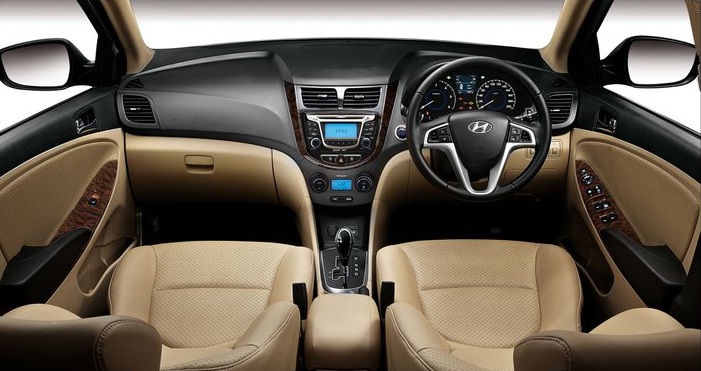
2011 New Hyundai Verna Interior Photos: